
How to Calculate Your Contractor Hourly Rate
You pay your carpenter $28 an hour and bill the customer $60. Feels like a $32 cushion.
Run the numbers and that $60 rate can leave you short. In the example below, labor, overhead, and nonbillable time push the actual cost to $75 per billable hour. At $60, you’d lose $15 an hour, or $21,000 across 1,400 billed hours.
To calculate your contractor hourly rate, add your annual labor costs and allocated overhead, divide by your expected billable hours, and adjust for your target profit margin.
Contractor Hourly Rate = (Annual Labor Cost + Allocated Overhead) ÷ Annual Billable Hours ÷ (1 − Target Profit Margin)
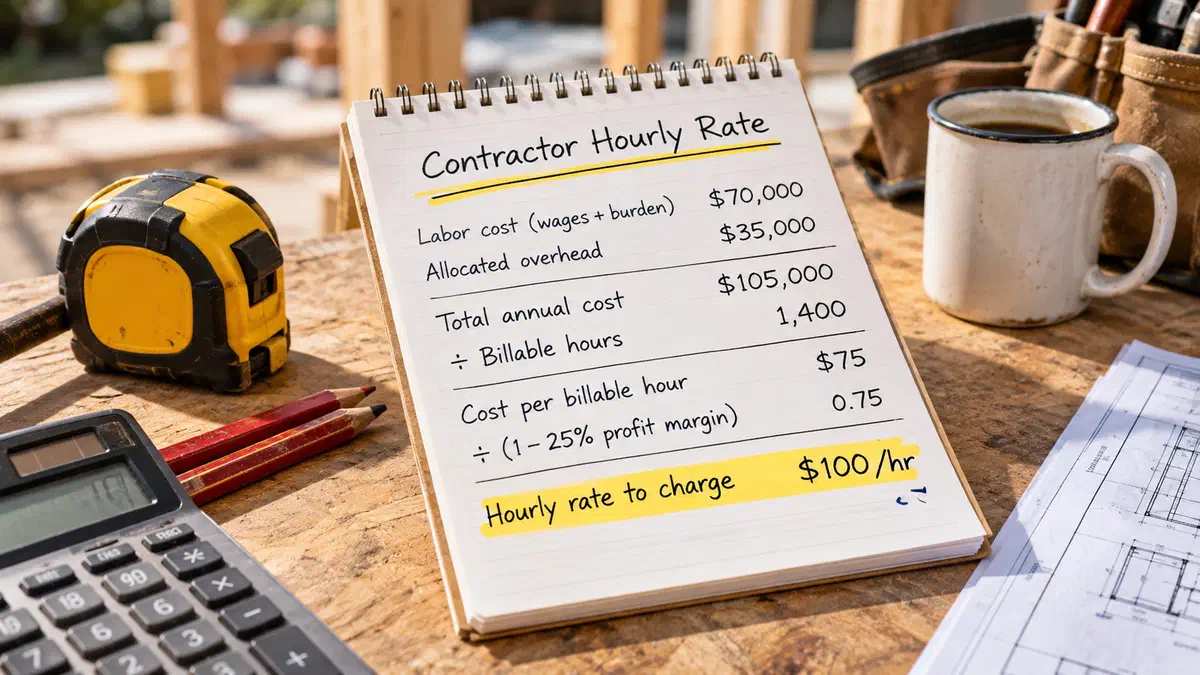
For example, a contractor with $105,000 in annual labor and overhead costs, 1,400 billable hours, and a 25% target profit margin needs to charge:
$105,000 ÷ 1,400 ÷ 0.75 = $100 per hour
That rate covers the costs in the calculation and leaves a 25% profit margin. It only works if you actually bill those 1,400 hours and get paid for them.
How to Calculate Your Contractor Hourly Rate in 4 Steps
We’ll use a small carpentry contractor with one field employee. The wages, expenses, and percentages are fictional examples, not industry averages.
Step 1: Calculate Your Annual Labor Cost
Your carpenter earns $28 an hour and gets paid for 2,000 hours a year.
$28 × 2,000 = $56,000 in annual wages
A carpenter earning $28 an hour doesn’t cost the business $28 an hour. You’ve also got employer payroll taxes, workers’ compensation, unemployment insurance, and any benefits you provide.
Those additional expenses make up your labor burden.
For 2026, employers pay 6.2% in Social Security tax on covered wages up to $184,500, plus 1.45% in Medicare tax. That’s 7.65% in employer FICA taxes on wages below the Social Security limit.
There’s also federal unemployment tax (FUTA). The standard rate is 6% on the first $7,000 in wages per employee. Employers qualifying for the full state unemployment tax credit pay an effective 0.6%, or $42 per employee earning at least $7,000. Credit reductions and other circumstances can increase that amount.
The IRS Employer’s Tax Guide explains these rules.
State unemployment taxes, workers’ compensation, benefits, and other employer costs add to the burden. Use your payroll records and insurance bills to calculate the actual amount.
For our example, we’ll use a 25% labor burden.
Labor Burden = Annual Wages × Burden Percentage
$56,000 × 25% = $14,000
Add that to wages:
$56,000 + $14,000 = $70,000 in annual labor cost
That works out to $35 per paid hour.
The 2,000 paid hours already include paid time off and holidays in this example. We’ve kept paid leave out of the additional 25% burden to avoid counting the same expense twice.
Cinderblock’s free Labor Cost Calculator can help you work out wages and labor burden. For a more detailed breakdown, see How to Calculate Construction Labor Cost.
Step 2: Calculate Your Billable Hours
Your carpenter’s on the clock 2,000 hours a year. You won’t bill all 2,000.
Material runs, drive time, the Monday safety meeting, shop cleanup, paid vacation. Some of that time may be built into your job prices, but it still takes time away from work you can bill directly.
Say 1,400 hours actually land on customer invoices.
Billable Utilization = Billable Hours ÷ Paid Hours × 100
1,400 ÷ 2,000 × 100 = 70% billable utilization
You’re paying for 2,000 hours and recovering the annual labor cost over 1,400.
$70,000 ÷ 1,400 = $50 per billable hour
Your $28 carpenter now costs $50 for every hour you bill.
Before overhead. Before profit.
If you don’t know your billable utilization, start with your last few months of time records. Compare total paid hours with the hours you’re actually charging customers for. If travel, setup, or cleanup is included in your flat-rate prices, account for that work consistently rather than treating it as lost time.
For a crew, add up the billable worker-hours. Two carpenters working eight billable hours each produce 16 billable worker-hours, not eight.
Step 3: Add Overhead per Billable Hour
You’ve also got bills that don’t belong to one specific job. General business insurance, office expenses, bookkeeping, software, advertising, and administrative wages all need to be covered.
Our small contractor allocates $35,000 in annual overhead to the carpenter’s work. That includes an allowance for the owner’s office and management time. The carpenter’s wages and employer costs are already covered in Step 1.
Overhead per Billable Hour = Allocated Annual Overhead ÷ Annual Billable Hours
$35,000 ÷ 1,400 = $25 per hour
Add it to the labor cost:
$50 labor + $25 overhead = $75 per billable hour
That’s the cost the business needs to recover before earning a profit.
The $35,000 represents all the company overhead being recovered through this carpenter’s billable work. If you have several field employees, spread the company’s overhead across their combined billable hours. Charging the full company overhead to every carpenter would inflate your rates.
For different ways to allocate these expenses, see How to Allocate Contractor Overhead to Each Job.
Step 4: Add Your Target Profit Margin
The $75 cost covers labor and allocated overhead. Your billing rate also needs room for the profit you’re aiming to earn.
Say your target profit margin is 25%.
Hourly Rate = Cost per Billable Hour ÷ (1 − Target Profit Margin)
$75 ÷ (1 − 0.25) = $100 per hour
Of every $100 billed:
- $50 recovers labor costs.
- $25 recovers allocated overhead.
- $25 is the target profit.
That $25 profit is 25% of the $100 selling price.
A 25% markup on $75 would produce a $93.75 billing rate, leaving a 20% margin.
If you’ve been using markup and margin interchangeably, read How Much Should Contractors Mark Up a Job? before setting your rates.
Contractor Hourly Rate Calculation Example
| Cost or Assumption | Amount |
|---|---|
| Carpenter’s hourly wage | $28 |
| Annual paid hours | 2,000 |
| Annual wages | $56,000 |
| Additional labor burden (25%) | $14,000 |
| Total annual labor cost | $70,000 |
| Allocated annual overhead | $35,000 |
| Total annual cost to recover | $105,000 |
| Expected billable hours | 1,400 |
| Cost per billable hour | $75 |
| Target profit margin | 25% |
| Required hourly billing rate | $100 |
Now go back to that $60 rate from the opening.
At $60 per hour, 1,400 billed hours bring in $84,000 in labor revenue. The business needs $105,000 to cover the labor and overhead allocated to that work. That’s a $21,000 annual shortfall.
At $100 per hour, those same 1,400 hours bring in $140,000. After the $105,000 in costs, the example leaves $35,000 in target profit.
The customer rate changes. The carpenter’s wages don’t.
How to Calculate Your Hourly Rate If You’re the One Doing the Work
A lot of small contractors are the estimator, scheduler, bookkeeper, and carpenter.
You might spend Monday installing cabinets, Tuesday pricing the next job, and Wednesday fixing a callback. All that time belongs in your pricing calculation, even if you pay yourself through owner draws instead of a regular paycheck.
Say you run a one-person carpentry business. You set an annual owner-compensation target of $60,000 for all 2,000 hours you work. That includes 1,200 hours of billable fieldwork and 800 hours spent estimating, ordering materials, managing jobs, and handling the office work.
Your billable utilization is:
1,200 ÷ 2,000 = 60%
The $60,000 is your total annual compensation allowance. If you’re a sole proprietor, plan that amount around what you need for living expenses, health insurance, and taxes.
The IRS lists the standard self-employment tax rate as 15.3%, made up of Social Security and Medicare taxes. The tax is calculated on qualifying net earnings under IRS rules, so you shouldn’t simply add 15.3% to every dollar of your desired take-home pay. See IRS Topic 554: Self-Employment Tax.
For this example, assume the $60,000 compensation target is sufficient for the owner’s planned personal obligations, including taxes and health insurance.
The business also has $24,000 in annual overhead for general insurance, vehicle and equipment expenses, software, bookkeeping, advertising, and other operating costs.
The $24,000 overhead excludes all owner compensation. Your $60,000 allowance covers both fieldwork and administrative time.
| Owner-Operator Calculation | Annual Amount |
|---|---|
| Total annual owner compensation allowance | $60,000 |
| Annual business overhead | $24,000 |
| Total annual cost to recover | $84,000 |
| Total annual working hours | 2,000 |
| Expected billable field hours | 1,200 |
| Cost per billable hour | $70 |
| Target business profit margin | 20% |
| Required hourly billing rate | $87.50 |
The calculation is:
$84,000 ÷ 1,200 ÷ 0.80 = $87.50 per hour
At that rate, 1,200 billed hours produce $105,000 in annual revenue. After the $60,000 compensation allowance and $24,000 overhead, the business has $21,000 in target profit.
How the owner’s compensation and business profit appear on a tax return depends on the business structure.
When you calculate your own rate, make sure your compensation target accounts for the time you spend running the business. Otherwise, you can work all week swinging a hammer and discover that the business paid everyone except you.
How Fewer Billable Hours Increase Your Contractor Labor Rate
Our carpentry contractor expects 1,400 billable hours. But a slow month, too many callbacks, or a crew spending more time running for materials can change that.
The business still has $105,000 in annual costs to recover.
| Annual Billable Hours | Cost per Hour | Rate for 25% Margin |
|---|---|---|
| 1,600 | $65.63 | $87.50 |
| 1,400 | $75.00 | $100.00 |
| 1,200 | $87.50 | $116.67 |
| 1,000 | $105.00 | $140.00 |
Lose 200 billable hours and the required rate jumps from $100 to $116.67.
That’s almost $17 more per hour just to reach the same target margin.
Raising your rate might help. So might getting more of the crew’s paid time onto revenue-producing work.
Check what’s eating those hours. Material pickups? Poor scheduling? Estimates that take half a day? Jobs that keep coming back for repairs?
Some time can be recovered through better planning. Other activities are part of operating the business and need to be included in your pricing.
Should Contractors Charge by the Hour or by the Job?
Hourly rates work well for service calls, troubleshooting, time-and-materials work, and jobs where the scope may change.
Fixed-price work still needs accurate labor pricing.
Say you’re estimating a deck repair requiring 24 billable worker-hours. Your calculated billing rate is $100.
24 × $100 = $2,400 in labor revenue
That gives you the labor portion of the quote. You still need to price materials, equipment rentals, subcontractors, permits, disposal, and other direct costs outside the labor calculation.
Since all your company overhead is already built into the labor rate, add appropriate profit and handling charges to materials and subcontractors without allocating the same overhead again.
For example, if a supplier charges you for delivery, include that expense in the materials cost. If your crew spends time collecting materials, account for those labor hours consistently. If you want profit on the materials you supply, price that separately.
This is one way to build a fixed-price estimate. Other contractors allocate overhead across total job costs instead of labor hours. Either method can work if the full business cost is recovered once.
If you use Cinderblock’s free Job Pricing Calculator, enter the underlying labor cost rather than the $100 billing rate, since the calculator applies a target margin to the costs entered. Include your allocated overhead once in the appropriate cost field.
A 25% margin on labor alone also doesn’t guarantee a 25% margin across the company. Your overall result depends on how you price materials, subcontractors, and other work.
Common Mistakes When Setting Contractor Labor Rates
Assuming Every Paid Hour Is Billable
If you pay for 2,000 hours but bill only 1,400, using 2,000 in the denominator spreads your labor costs across 600 hours you won’t sell as separately billed labor.
In our example, that mistake makes the $70,000 labor cost look like $35 per hour instead of $50 per billable hour. That’s a $15 difference before adding overhead.
Forgetting to Pay Yourself
Owners who work in the field need to account for their own labor.
Your time installing cabinets or repairing a roof belongs in the labor calculation. The hours you spend managing employees, answering calls, and preparing estimates also need to be covered somewhere in your cost structure.
Keep owner compensation and business profit separate. If you’ve already included owner compensation in the labor allowance, don’t add it again as overhead.
Counting the Same Expenses Twice
Workers’ compensation might already be part of your labor burden. If you also put that premium into overhead, you’ll charge for it twice.
Paid leave can cause the same problem. If annual wages already include paid time off, account for the reduced billable hours without adding the same leave wages again.
Use the same approach for vehicle costs, equipment, and office staff.
Confusing Markup With Profit Margin
Your labor and overhead cost is $75 per billable hour.
A 25% markup gives you a billing rate of $93.75. A 25% profit margin requires $100.
That’s a $6.25 difference on every billed hour.
Use the free Markup & Margin Calculator to check the two calculations when setting your prices.
Copying Another Contractor’s Rates
The contractor down the road charges $85 an hour. Maybe they own their shop outright. Maybe they have three trucks on payments. Maybe they’re losing money.
You can’t tell from the price alone.
Check what competitors charge in your market, but calculate your own costs first. If the rate you need is higher than customers will pay, look at your expenses, workload, services, and pricing model.
How to Know Whether Your Hourly Rate Is Working
You calculated a $100 hourly rate using 1,400 expected billable hours. Six months later, you’ve billed 520.
You’re 180 hours behind the 700-hour pace needed at the halfway point.
Pull your time records and see where those hours went. Then compare actual payroll expenses, overhead, and customer payments with the assumptions you used when setting your rate.
If wages have gone up or your insurance renewed at a higher premium, recalculate the cost per billable hour. If jobs keep running 20% longer than estimated, revisit your labor allowances. A good hourly rate won’t rescue a fixed-price job that consistently uses more hours than you quoted.
Cinderblock’s time tracking and job costing features, available on the Build plan, help keep recorded labor hours and costs connected to jobs. You can use those records to compare estimates with the work completed.
You’ll still need company accounting records to calculate overhead and set your hourly rate. Your job records help show where the estimates missed.
For our example carpentry contractor, the calculated rate is $100 per hour. Yours will depend on your wages, expenses, billable hours, and profit target.
Rerun the calculation at least once a year, and whenever wages, insurance, overhead, or workload change.

Andrew Booth
Andrew is a construction industry writer focused on contractor operations, scheduling, estimating, and field workflows.


